

Tencent’s Hy4 Topped This Week’s Chinese AI “Win.” It Wasn’t About Being Cheap
Examining the factors behind Tencent's Hunyuan Hy4's rise in AI model usage beyond just cost.
For months, English-language coverage of China's AI models has settled on one throughline: they win because they're cheap. Chinese vendors, running open-weight models, have undercut American frontier labs by anywhere from 60 to 90 percent on a per-token basis, and enterprise buyers have followed the discount. That was the frame reached for again this week, when Tencent's Hunyuan Hy4 preview became the single most-used model on OpenRouter, the developer platform many AI teams treat as a real-time gauge of what the industry is actually running.
Hy4 preview doesn't fit the frame it's being read into. Tencent's own pricing, mirrored on OpenRouter's listing, is $0.834 per million input tokens and $2.501 per million output tokens. That's roughly eleven times what Z.ai charges for GLM-5.3 Flash — one of the models Hy4 preview displaced from the top of the chart — and it sits well above several other Chinese options that were themselves marketed on cost. The comparison to U.S. models is murkier: published rates for OpenAI's GPT-5.6 Luna vary by source and billing tier, from roughly $0.20 to $1.00 per million input tokens. But on OpenRouter's standard listing, at least, Hy4 preview isn't the discount option in the room. If the usage chart simply rewarded the cheapest model, this shouldn't have been the week it changed hands.
There's also a question of what the chart is measuring in the first place. OpenRouter aggregates traffic from developers and companies that route API calls through its platform — a population that, by OpenRouter's own published research, skews heavily toward English-language, developer-centric use. That makes it a reasonable proxy for how much international traction a model has picked up outside China, and a poor proxy for how the model is used inside China, where most volume moves through domestic clouds, apps, and enterprise contracts that never touch OpenRouter at all. Read that way, this week's leaderboard looks less like a scoreboard of "China vs. the U.S." and more like a snapshot of which Chinese lab is currently winning over developers who shop across providers. Is a company's position on that chart a measure of Chinese AI use overall, or mainly of how well one lab's international distribution and pricing happen to be working this month? The data alone doesn't settle it — and coverage that treats the OpenRouter leaderboard as a stand-in for "how much AI China is using" is arguably answering that question by default, without saying so.
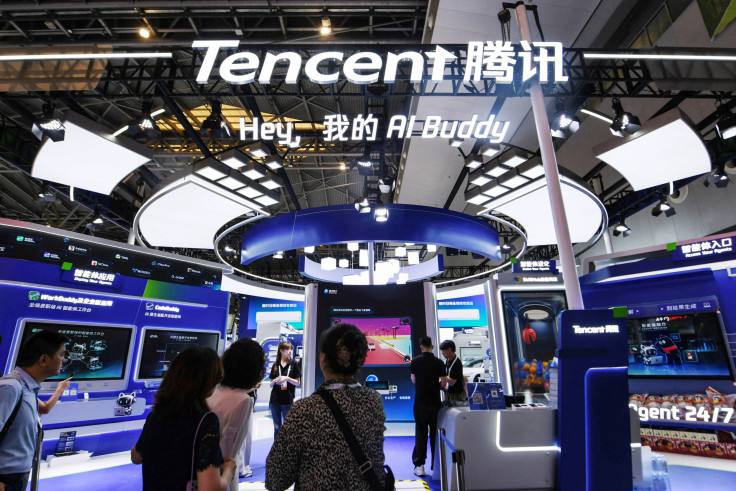
The timing of the surge is worth putting on the record too. Hy4 preview launched on August 28, and Tencent has offered free access to it through two of its own products, WorkBuddy and CodeBuddy, for two weeks from that date — a window that covers essentially this entire reporting period. A jump of this size, in the exact stretch when a major access route to the model was free, doesn't by itself prove the promotion caused the spike; the model's open-weight release and genuine interest in its long-context architecture plausibly contributed too. But the overlap is close enough that reporting the usage number without mentioning the free-trial window risks implying something steadier than what the data shows. A number driven partly by a two-week promotion is a different kind of signal than one driven by developers choosing to keep paying once the free period ends — and it will be worth watching whether Hy4 preview holds its position once WorkBuddy and CodeBuddy access reverts to standard pricing later this month.
None of this means Chinese AI models aren't gaining real ground. The broader trend of rising Chinese-model usage on infrastructure like OpenRouter is well documented elsewhere and mostly measures something genuine. But the specific claim attached to this week's number — cheap pricing driving a usage win — is more fragile than the headline suggests, and untangling promotion, platform bias, and price from underlying demand is worth doing before the figure gets cited as more settled evidence than it is.