

50% Tariff Ceiling Hits Canada: Why Toyota and Honda Are More on Edge Than Detroit
Understanding the implications of the US's 50% tariff ceiling on Canadian imports and its impact on the automotive industry.
50% Tariff Ceiling Hits Canada: Why Toyota and Honda Are More on Edge Than Detroit
The United States raised additional tariffs on Canada to the highest level permitted by law. Beginning at 12:01 a.m. Eastern Time on Aug. 22, the United States started imposing additional ad valorem duties on some goods imported from Canada under Section 338 of the Tariff Act of 1930, at rates of up to 50%. The phrase "an additional ad valorem tax not exceeding 50%" is precisely the cap on presidential authority set by Section 338 — this is not an outlandish bargaining position at the negotiating table, but the statutory maximum.
On Sept. 3, Canadian Prime Minister Carney publicly said that as long as the United States is ready, Canada is always ready to sit down and reach an agreement, but any future agreement must have "stability and credibility," and the competitiveness of autos, steel and aluminum cannot be sacrificed. Trump promptly responded on social media, warning that if Canadian politicians treat the U.S. side as an enemy, Canada will face economic consequences like "collapse."
The response is also under way. The Canadian government published a retaliation list on Aug. 25: starting Sept. 8, it will impose duties at three tiers — 15%, 25% and 50% — on about 700 categories of U.S. products, with the total amount equal to that of the U.S. side.
The real question worth probing is: On Aug. 20, Canada's trade minister still said an agreement was "very close," so why did negotiations break down at the last minute on Aug. 21, and why did they immediately reach the ceiling tariff rate? The answer lies not in the trade deficit but in three words — rules of origin.
The Three Proclamations Target Canada's Domestic Policies
A close reading of the White House proclamation issued on Aug. 18 reveals a straightforward logic. For this action, the U.S. side is deploying three parallel proclamations: Proclamation No. 11046, signed July 20, targets alcoholic beverages, finding that Canada prohibits the purchase, distribution or retail sale of U.S. alcoholic beverages while not imposing equivalent restrictions on its own domestic market; No. 11047 targets dairy products, pointing to Canada's tariff-rate-quota allocation method for various U.S. cheeses; and No. 11048 targets motor vehicles, pointing to Canada's automotive tariff regime.
All three proclamations state that the legal basis for imposing duties is Section 338 of the Tariff Act of 1930 (19 U.S.C. 1338). The authorization under this provision is unusual: once the president determines that a country is discriminating against the commerce of the United States or imposing discriminatory or unequal application, the president may declare an additional ad valorem tax not exceeding 50%; however, it may not take effect earlier than 30 days after the proclamation of determination, and the president may suspend or modify it at any time.
This also explains the "three-day pause" on Aug. 18. The text of the proclamation states that the suspension was ordered because senior officials reported that "Canada has expressed its willingness to remove the relevant discriminatory measures" and that the two sides were still negotiating; the proclamation simultaneously changed the original Aug. 19 effective date to Aug. 22 at 12:01 a.m. Those three days were the final buffer for negotiations: if a deal was reached, the duties would not be imposed; if talks collapsed, they would take effect on the new date.
More importantly, the U.S. side is not attacking "you are selling too much," but "your own rules discriminate against my products" — the alcoholic beverages, cheese and autos categories all point to Canada's domestic policy instruments. Because the tariff rates derive from a "presidential determination," the determination itself can be redone. For Ottawa, the frightening thing is not this one 50% round, but that the same legal pathway can be activated again at any time. That is precisely why Carney has placed "stability and credibility" as the first demand in negotiations (this layer is an analytical inference based on the text of the proclamations, not a public statement by either side).
The $20 Billion Figure Is Read From Ottawa's List
The U.S. proclamation only states that duties will be imposed on "certain goods imported from Canada," without disclosing the total value involved. The circulating figure of "about $20 billion" actually comes from the Canadian side: in its full retaliation list, the Canadian government said that because the United States has imposed 50% tariffs on C$27.6 billion of Canadian goods starting Aug. 22, Canada will implement countermeasures of equal value; media converted C$27.6 billion to about $20 billion and said it accounts for about 7% of the total value of U.S. exports to Canada. In other words, "$20 billion" is first an anchor for reciprocal retaliation, not a figure given by the U.S. side; the two sets of figures cannot be mixed.
On Aug. 27, Canada's Department of Finance made minor adjustments to the list: adding U.S.-made copper wire, charcoal and some glass containers and gypsum bricks to the 50% tier, while removing fish and seafood. The key point is that the total value remained unchanged — the size of the package was unchanged, only the composition of goods was rearranged. The move itself sent a signal: Ottawa treats the reciprocal scale as a domestic political commitment, while keeping specific products as bargaining chips that can still be traded. Canadian Trade Minister LeBlanc said the preferred option remains reaching an agreement that benefits both countries, but "we will not sit there forever waiting for the United States to call."
The Talks Did Not Collapse Over Tariff Rates, but Over Whose Yardstick Is Used to Calculate Content
Judging from the proposed terms reported by the media, the real deadlock between the two sides lies in how autos and steel are calculated. The Globe and Mail, citing people familiar with the matter, said the U.S. side at one point agreed to cut tariffs on Canadian autos from 25% to 15%, but the exemption would recognize only "U.S.-origin content," rather than the "North American content" sought by Canada; experts estimated that the effective tariff rate calculated under this method would be about 7.5%. At the same time, the U.S. side refused to extend the tariff cut to medium- and heavy-duty trucks — exactly the type of vehicles mainly produced at Ford's plant on the outskirts of Toronto.
Steel would be divided by quota: reportedly, the two sides discussed setting an annual tariff-rate quota of 4 million tons for Canadian steel exports to the United States, with 25% tariffs applied within the quota and 50% tariffs maintained above it — that is, the current Section 232 tariff rates; in exchange, Canada agreed to remove all retaliatory tariffs on U.S. steel and further restrict imports of steel from third countries.
These terms remained at the "proposed" level and became void when negotiations collapsed on Aug. 21, but the nature of the disagreement is clear: whether the tariff rate is high or low is a number, while "who is counted in local content" determines whether a production line can survive.
Trump's remarks on Aug. 24 made this layer more explicit: he said that starting Jan. 1, 2027, tariffs on cars, trucks, auto parts and steel imported from Canada would be raised to 50%, for the first time including trucks and components together. But this currently exists only in media reports and presidential remarks; there is not yet an official document.
Why Toyota and Honda Are More Nervous Than Detroit
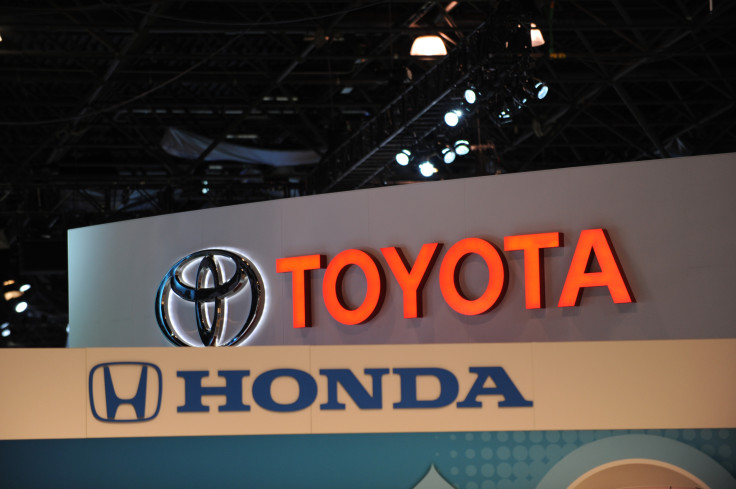
The market's initial intuition was that General Motors, Ford and Stellantis would be hit hardest. But industry estimates cited by Cailian Press offer a different answer: Canada's annual auto production is about 1.2 million vehicles, more than three-quarters of which are produced by Toyota and Honda; JPMorgan estimated that last year, Canadian-made vehicles accounted for about a quarter of Honda's U.S. sales and about 17% of Toyota's U.S. sales, involving some RAV4 and CR-V models assembled in Canada. If tariffs rise to 50%, the first place under pressure will not be Michigan, but assembly lines in Ontario.
Costs have also not been passed immediately to U.S. consumers. Oxford Economics estimates that current U.S. new-car prices are only about 0.4% higher than the "no-tariff trend," indicating that manufacturers and dealers are absorbing costs themselves; if the full amount were passed on, the gap should have been close to 5%. The same institution estimated that with tariffs under Section 338 taking effect, the U.S. overall effective tariff rate has risen by about 0.2 percentage points to 9.9%; if auto tariffs are further stacked, it could rise to 10.1% or 10.4%, depending on whether goods that comply with USMCA rules can obtain exemptions.
Indicators on the Canadian side are also worsening. The Bank of Canada said on Sept. 2 that upside risks to inflation have increased and that new tariffs have made the growth outlook more uncertain. Carney's government announced C$4.7 billion in investment to build and maintain capacity for VIA Rail passenger cars in Ontario and elsewhere, shifting some vehicles originally produced in the United States to domestic manufacturing. The money is currently only an announced amount and remains far from becoming production capacity.
For Chinese Companies: All Three Pathways Remain Unsettled
The first is the codification of third-country restrictions. Reportedly, earlier negotiations sought to require Canada to further restrict steel imports from third countries. If such provisions return to the text of an agreement, metals and some components that enter the U.S. market through processing or transshipment via Canada will come under direct pressure.
The second is tightening of the rules-of-origin measure. The U.S. side recognizes only "U.S.-origin content," not "North American content," which in practice squeezes room for "performing final assembly within the region." For exporting companies trying to use Mexico or Canada as a springboard into the U.S. market, pricing rules may be more damaging than tariff rates (this is analysis based on the direction of the provisions and does not constitute an established fact).
The third is the pace of regional investment itself. Honda has said that if the formal USMCA is not approved, it will reassess plans to build new plants in the United States. Once the survival of an integration agreement begins to become a variable, capacity allocation across North America is no longer optimized according to cost, but rearranged according to policy risk.
Four Milestones to Watch Next
Sept. 8, when Canada's retaliatory tariffs take effect, to see whether the list is tweaked again on the eve of implementation; Jan. 1, 2027, to see whether Trump's threatened 50% tariffs on Canadian cars, trucks, components and steel move from remarks into official documents; the USMCA review window, with some Canadian provincial officials warning that accepting long-term tariffs would weaken the "leverage to revisit the United States-Mexico-Canada Agreement later this year or early next year," but that timetable has appeared only in media reports; and Ottawa's alternative ledger, whether the C$4.7 billion rail-passenger-car investment and the 7.5 billion aid plan, whose currency denomination remains inconsistent, can translate into verifiable capacity and employment.
What is worth remembering is: the seams of the North American supply chain are no longer determined by cost curves, but by how a 1930 legal provision is reinterpreted and how the phrase "local content" is calculated.
Reference data sources
- The White House · Presidential proclamation dated Aug. 18, 2026 (citing Proclamations Nos. 11046–11048 and Section 338 of the Tariff Act of 1930) · Aug. 18, 2026 · https://www.whitehouse.gov/presidential-actions/2026/08/temporary-suspension-of-additional-duties-to-offset-canadian-discrimination-against-the-commerce-of-the-united-states-with-respect-to-alcoholic-beverages-dairy-and-motor-vehicles/
- Wall Street CN · U.S.-Canada "exchange fire" at a distance: Carney says a deal is negotiable but autos, steel and aluminum cannot be sacrificed · Sept. 4, 2026 · https://wallstreetcn.com/articles/3781031
- Cailian Press · Trump plans additional tariffs on Canadian autos — why are Toyota and Honda the biggest victims? · Sept. 1, 2026 · https://www.cls.cn/detail/2471238