

Hong Kong Is Writing Its First Five-Year Plan. Consultation Closed Last Week
Exploring the Implications of Hong Kong's Inaugural Five-Year Plan Aligned with China's National Strategy
Hong Kong has never had a five-year plan. It is about to.
Public consultation on the First Five-Year Plan for the Economic and Social Development of Hong Kong, covering 2026 to 2030, closed on 14 August. The document is expected to be published in September, alongside Chief Executive John Lee's fifth and final policy address of his term.
The significance is procedural before it is political. Hong Kong has historically governed through annual policy addresses and budgets — a yearly cycle of commitments and accounting. A five-year plan is a different instrument, setting medium-term direction against which annual measures are then assessed.
Lee has described the relationship directly: the five-year plan sets overall direction while the policy address outlines concrete measures, with the policy address serving as the annual report on implementation of the plan. He is personally leading a cross-departmental task force on the drafting.
Aligned with Beijing's cycle
The timing is not incidental. Hong Kong's plan covers the same 2026 to 2030 window as China's 15th Five-Year Plan, and Lee has said the city will launch its first blueprint in step with the national one.
For readers outside Hong Kong, that alignment is the most consequential detail. Five-year planning is the characteristic instrument of mainland economic governance, and its adoption in Hong Kong represents a change in method rather than merely a new document. Lee has framed the city's position in terms of holding what he describes as the unique advantages of strong support from the mainland while remaining closely connected to the world under one country, two systems.
Interpretations of what the shift signifies differ, and are likely to continue differing. What is not in dispute is that the planning cycle is new.
How it was assembled
The consultation was unusually extensive by Hong Kong standards.
The government conducted more than 80 online and in-person sessions with sector representatives. By late June it had received close to 1,000 submissions, a figure that grew substantially through the remainder of the exercise. Lee held three consecutive days of working luncheons with his Council of Advisers from 28 to 30 July, joined by newly appointed members including Sun Piaoyang of Jiangsu Hengrui Pharmaceuticals and Xu Tao of StarFive Semiconductor Technology.
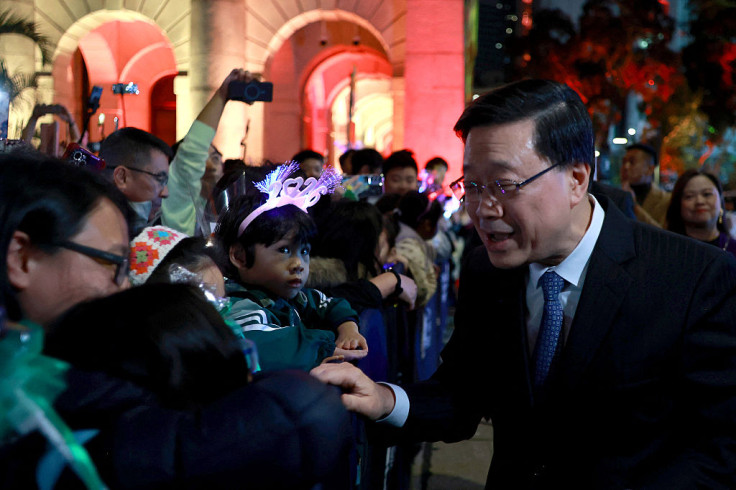
District forums followed. The first, on 2 August at South Tuen Mun Government Secondary School, drew about 130 participants across two hours in small-group format under twin themes of economic development and livelihoods. Only residents and district representatives selected by the government were invited. A second forum at Kowloon Tong Government Primary School drew around 120 participants, attended by Chief Secretary Eric Chan, Financial Secretary Paul Chan and Deputy Secretary for Justice Horace Cheung.
There is also a new institutional arrangement. Legislative Council President Starry Lee has said that for the first time, LegCo and the government established a joint mechanism to gather public views, with LegCo members presenting research findings and a compendium to assist drafting. She has indicated LegCo will invite the chief executive to a dedicated exchange session once the plan is published.
What residents raised
The concerns surfacing at the district forums cluster around demographics and housing rather than the financial-hub priorities that dominate government messaging.
Participants raised the housing ladder for young people, the declining birth rate and a shrinking labour force. Lee responded that talent policies would be demand-driven and that a related manpower study would be released within the year. Discussion at the tertiary education consultation centred on construction of the Northern Metropolis University Town.
A councillor at the Tuen Mun forum pressed for faster regeneration of Tsuen Wan, with Lee signalling closer attention to urban management.
Those themes — an ageing population, a contracting workforce, housing affordability — are the ones a five-year horizon is better suited to addressing than an annual budget, which may be part of the argument for adopting the instrument.
The political context
This is Lee's final policy address before his term concludes, which gives the pairing additional weight: an outgoing administration setting a five-year direction its successor will inherit.
Public sentiment measurement is contested, as it generally is in Hong Kong. A poll published in June by a pro-establishment newspaper reported 67% of respondents satisfied with the current administration's work. That figure should be read with its source attached.
What to watch
Publication is the immediate event. A September release would put the plan in the public domain shortly before or alongside the policy address, and the degree of specificity will matter — whether it sets measurable targets or states directional priorities.
The second is the LegCo exchange session Starry Lee has flagged. A dedicated session on a five-year plan would be a new format for the council, and how it is conducted will indicate the plan's intended standing.
The third is the manpower study Lee has promised within the year. Labour force contraction was the most consistently raised concern across consultation sessions, and the study is the government's specific commitment in response.